1

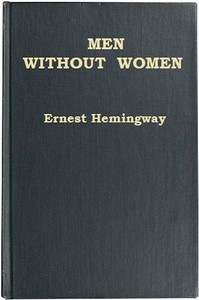
Men without women — Edition Insights
272
2
Project Gutenberg
2023
Short stories, American; American fiction -- 20th century; Adams, Nick (Fictitious character) -- Fiction
Readers of public-domain and historical texts
Project Gutenberg digital edition
en
Edition facts
Words: 45,761
Reading time: 199 min
Text sections: 6
Source:
Project Gutenberg record #69683
Hemingway's 1927 collection of fourteen stories, including 'The Killers' and 'Hills Like White Elephants,' showcases his trademark spare dialogue and understated prose. The narratives explore masculinity, loss, and stoicism through bullfighters, boxers, and soldiers, often leaving emotions unspoken.
Editorial Edition Score
4.7/5
★★★★★
★★★★★
Calculated from edition completeness, EPUB availability, text structure and catalogue metadata. Not a user rating.
Edition quality
Hemingway's Men Without Women (1927) opens with Manuel Garcia climbing stairs to a bullfight promoter's office, a scene that immediately establishes the collection's preoccupation with physical labor, taciturn exchanges, and unspoken codes. The prose is lean: 'He set down his suitcase and knocked on the door. There was no answer.' This economy of language, where gesture and silence carry as much weight as speech, defines the volume's narrative voice. Across fourteen stories, Hemingway tests how much can be conveyed through what is left unsaid—a technique that becomes especially pointed in dialogues where characters circle each other without direct confrontation.
The Weight of Unspoken Words
Throughout the collection, Hemingway's dialogue often operates as a form of evasion. In 'The Killers,' the exchange between the hitmen and the diner's cook is clipped and menacing: 'What are you going to kill him for?' 'We're going to kill him for a friend. Just to oblige a friend.' The repetition and flatness of the replies create a surface calm that barely conceals violence. Similarly, in 'Fifty Grand,' the narrator's observations of boxer Jack Brennan are filtered through understated remarks: 'He's pretty bad,' 'He don't sleep.' The characters rarely name their fears directly; instead, the reader infers exhaustion, dread, and physical decline from what is not said. This technique forces attention to small gestures—a knock on a door, a glance at a stuffed bull's head—that carry emotional weight.
Pace and the Compression of Time
Hemingway modulates narrative speed by alternating between sparse summary and extended, real-time scenes. In 'The Undefeated,' the bullfight is rendered in a series of short, present-tense paragraphs that mimic the rhythm of the ring: 'The bull charged. Manuel swung the cape. The bull passed.' The action is abrupt, almost staccato. Yet earlier, the negotiation with Retana unfolds in a slower, more circular exchange, with pauses and repetitions that suggest Manuel's desperation. In 'Fifty Grand,' the training-camp sequences are filled with idle talk and waiting—'We were out on the porch again'—that stretches time, making the eventual fight feel both inevitable and deferred. This contrast between languid preparation and sudden violence gives the collection its distinctive pulse.
Recurring Motifs: Hands, Rooms, and the Body
Hemingway anchors his stories in physical details that recur across the collection. Hands are prominent: Manuel 'knocked with his knuckles on the desk'; Jack Brennan lies 'face down and his face was in the pillow. Both his arms were around the pillow.' These gestures convey vulnerability or assertion without commentary. Rooms are often confined—offices, hotel rooms, training quarters—and characters enter them with a sense of trespass or negotiation. The body itself becomes a site of strain: boxers who cannot sweat, bullfighters who feel 'a certain family interest' in a stuffed bull that killed their brother. These repeated, concrete images create a cohesive world where physical facts stand in for emotional states, and the reader learns to read the body as text.
Reading Men Without Women rewards attention to what Hemingway withholds. The stories do not explain their characters' motives; they present actions and speech, leaving the reader to infer the tensions beneath. Pay particular notice to moments of silence—when a character does not answer, or when a scene ends abruptly. These gaps are where the collection's emotional force resides. The spare style is not a lack of meaning but a deliberate discipline, one that asks the reader to listen as carefully as the characters do not speak.
Reader reflection
How did this book work for you?
Your answers remain private and are stored only in this browser.
Your progress
0
/
10
2
Did this book hold your interest?
3
How likely are you to recommend this book?
4
Did the language feel accessible?
5
Was the book easy to understand?
6
What was its emotional impact?
7
Was the book what you thought it would be?
8
Would you start a conversation about this book?
9
In one sentence, what did you learn?
10