1

The terrors of the upper air — Key Ideas to Explore
339
2
Project Gutenberg
2024
Short stories; Criminals -- Fiction; Air pilots -- Fiction
Readers of public-domain and historical texts
Project Gutenberg digital edition
en
Edition facts
Words: 9,621
Reading time: 42 min
Text sections: 1
Source:
Project Gutenberg record #73477
A detective story that ascends into aerial horror: Pemberton tracks bank robbers who escaped by plane into a deadly realm of flying alligators and devil-fish above the clouds, told through a breathless first-person account.
Editorial Edition Score
4.4/5
★★★★★
★★★★★
Calculated from edition completeness, EPUB availability, text structure and catalogue metadata. Not a user rating.
Edition quality
The story opens with a classic detective setup—Pemberton, the Great Detective, confronts the President of the State Fair about two aviators, Kidwell and Dexter, whom he suspects of a bank robbery. The robbery involved a half-million dollars and a murder, and the criminals escaped by plane from a surrounded woods. The detective’s reasoning hinges on a tiny clue: two small cuts in an airplane tire. This grounded, clue-driven beginning soon gives way to something far stranger.
From Detective Work to Aerial Descent
The narrative shifts abruptly from Pemberton’s investigation to a first-person account of the aviators’ flight. The reader is plunged into a desperate chase above the clouds, where the familiar world of police work is left behind. The aviators, pursued by monstrous flying creatures, must navigate a sky filled with floating islands and deadly predators. The transition is jarring, moving from the orderly logic of detection to the chaos of survival. The story’s structure mirrors this shift: the detective’s methodical reasoning is replaced by a breathless, present-tense report of events unfolding in real time.
The Monsters of the Upper Air
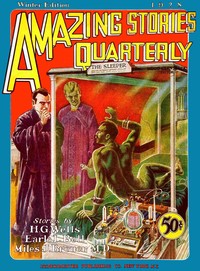
The creatures encountered are described with visceral specificity: flying alligators with bat-like wings, devil-fish that shatter propellers, and an octopus-like entity that battles an alligator on a floating island. The narrator notes their flight pattern—rising and falling with each wingbeat—and their terrifying speed, twice that of the aviators’ plane. The monsters are not merely background threats; they drive the action, forcing the aviators into a desperate race to the edge of a floating island. The description of the alligator’s scream, “like a thousand wild cat whistles,” and the sight of its torn wings ground the horror in physical detail.
A Race Against Time and Gravity
The chase sequence is the story’s core, a sustained passage of mounting tension. The aviators, low on fuel and altitude, are surrounded by a dozen monsters. The narrator counts down the distance to the edge of the island, calculating speeds and odds. The prose becomes fragmented, with short sentences and exclamations: “God, it has turned and is headed after us.” The climax arrives when a devil-fish shatters the propeller, and the aviators fall onto the island’s edge. The story ends mid-sentence, leaving the outcome uncertain—a deliberate structural choice that emphasizes the chaos of the moment.
The Detective’s Return and the Unresolved Mystery
After the aerial ordeal, the narrative returns to Pemberton, who receives a report of the aviators’ fate. The detective’s role is reduced to a listener; the true action has already occurred. The story’s frame—a detective story that becomes a survival tale—raises questions about the nature of crime and punishment. The aviators, initially criminals, become victims of a world beyond human law. The ending, described as “typical O. Henry” in the introduction, suggests a twist, but the excerpts do not reveal it. The reader is left to ponder whether the terrors of the upper air are a literal threat or a metaphor for the consequences of transgression.
The story’s structure—a detective frame enclosing a first-person survival narrative—creates a tension between order and chaos. Readers should pay attention to the shift in voice and the way the monsters are described with both scientific precision and awe. The incomplete ending invites speculation, but the evidence suggests a story that values atmosphere and suspense over resolution.
Reader reflection
How will you remember this book?
Save your reaction, strongest insight, and memorable passage.
Your progress
0
/
10
2
Did this book hold your interest?
3
Would you recommend this book to another reader?
4
Did the language feel accessible?
5
How did the reading compare with what you expected?
6
How clearly were the main ideas presented?
7
Did anything about the book feel genuinely new?
8
Would you like to discuss this book with someone?
9
What is the main idea you are taking away?
10