1

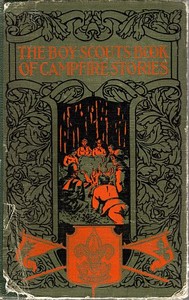
The Boy Scouts Book of Campfire Stories — A Closer Reading
921
2
Project Gutenberg
2008
Fiction; Short stories; Storytelling
Readers of public-domain and historical texts
Project Gutenberg digital edition
en
Edition facts
Words: 77,463
Reading time: 337 min
Text sections: 8
Source:
Project Gutenberg record #26475
An editorial note on Franklin K. Mathiews' anthology of adventure tales for Boy Scouts, examining how the stories balance thrilling outdoor action with moral instruction, as seen in excerpts from Jack London's 'That Spot' and the editor's introduction.
Editorial Edition Score
4.7/5
★★★★★
★★★★★
Calculated from edition completeness, EPUB availability, text structure and catalogue metadata. Not a user rating.
Edition quality
Franklin K. Mathiews, Chief Scout Librarian, opens this collection by asserting that the campfire has long been "the place of council and friendship and story-telling." The introduction explicitly links story selection to the developmental needs of boys in their early teens, quoting Professor George Walter Fiske on the value of emulating "savage woodcraft" and the woodsman's "contempt for pain, hardship and the weather." This framing suggests the stories are chosen not merely to entertain but to shape character—a tension between raw adventure and didactic purpose that runs through the volume.
The Editor's Blueprint for Boyhood
Mathiews' introduction is remarkably direct about its pedagogical aims. He presents the campfire as a tool for "council and friendship and story-telling," but the stories themselves are to serve as "companions for the mind" that "exalt and inspire while they thrill and entertain." The quoted passage from Fiske itemizes desired traits: keen vision, steadiness of nerve, endurance, observation, faithfulness, honesty, personal bravery. This list reads like a scout's code rendered in prose. Yet the excerpts that follow—such as Jack London's "That Spot"—often feature characters who are anything but model scouts: they scheme, trade dogs callously, and flee in fear. The editor's hope that the stories will "present companions for the mind of this hardy sort" sits uneasily alongside tales of superstition and moral ambiguity.
Unruly Companions: The Case of Spot
In the excerpt from "That Spot," the narrator recounts a dog that defies all rational explanation. Spot escapes from a tied rope, crosses the Klondike River without a trail, and reappears after being traded to a lost outfit. The narrator's tone shifts from bafflement to something like dread: "The more I think of that Spot, the more I am convinced that there are things in this world that go beyond science." The dog's uncanny ability to track the narrator and his partner Steve—"How did he know we were coming to Dawson, to the very hour and minute?"—turns the story into a meditation on the limits of human control. The narrator finally admits he "sneaked" away from the Klondike because Spot "got on my nerves." This is not the stuff of straightforward heroism; it is a tale of a man undone by a persistent, almost supernatural animal.
Voice and Vernacular in the Telling
The excerpt from "That Spot" is narrated in a colloquial, almost breathless style, full of rhetorical questions and direct address: "You tell me, and I'll tell you." The narrator's voice conveys both wonder and exasperation, as when he describes Spot's escape from the ice run: "We yelled and shouted and ran up and down the bank, tossing our hats in the air. Sometimes we'd stop and hug each other, we were that boisterous, for we saw Spot's finish." The language is vivid and specific—"perambulating skeleton," "a blamed sight harder to turn an ax aside"—and it creates a sense of oral performance. This fits the book's premise: stories meant to be told aloud around a fire. The editor's own prose in the introduction is more formal, but the contrast highlights the range of registers within the collection, from instructional preface to yarn-spinning vernacular.
Patterns of Escape and Pursuit
A recurring pattern in the excerpt is the motif of escape that fails. The narrator and Steve try to rid themselves of Spot by trading him, but he returns. They plan to eat him, but he "sneaked." They celebrate his apparent death in the ice, only to find him waiting at Dawson. Each attempt to be free of the dog tightens the knot. The narrator's final escape—leaving the Klondike altogether—is presented as a surrender: "I didn't say anything to Steve. I just sneaked." This inversion of the expected adventurous outcome—where the hero triumphs—suggests that the collection may contain stories that complicate the simple moral lessons the editor outlines. The tension between the desire for control (over nature, over animals, over one's fate) and the reality of persistent, inexplicable forces gives the excerpt its uneasy power.
The Campfire as Frame and Filter
The book's structure—an introduction followed by stories—creates a frame that invites readers to consider each tale in light of the editor's stated goals. Yet the excerpt from "That Spot" resists easy assimilation into a program of character building. The narrator is not a model of "calmness, self-control, emotional steadiness"; he is rattled, superstitious, and ultimately routed by a dog. The campfire setting, as Mathiews describes it, is meant to "quicken the mind" and "awaken memories of happy, glowing tales." But the story that follows is anything but happy—it is a chronicle of obsession and flight. This dissonance may be intentional, offering readers a more complex experience than the introduction promises. The frame does not erase the story's unsettling qualities; it highlights them.
Readers approaching this collection should be alert to the gap between the editor's stated aims and the actual texture of the stories. The introduction presents a clear program for moral and physical development, but the excerpts suggest that the tales themselves may resist such neat categorization. Pay attention to the narrators' voices—their hesitations, their humor, their admissions of fear. The campfire, as Mathiews notes, is a place of council and friendship, but it is also a place where strange things are told, and not all of them end with a lesson neatly learned.
Reader reflection
How will you remember this book?
Save your reaction, strongest insight, and memorable passage.
Your progress
0
/
10
2
Did this book hold your interest?
3
Is this a title you would suggest to others?
4
What was the reading difficulty like?
5
How did the reading compare with what you expected?
6
How clearly were the main ideas presented?
7
Did this book create an emotional response?
8
How distinctive were its ideas or approach?
9
What did this book teach you most?
10


![Cover of Some Short Stories [by Henry James] — Inside the Classic](https://cuiep.com/storage/media/covers/pg2327.jpg)