1

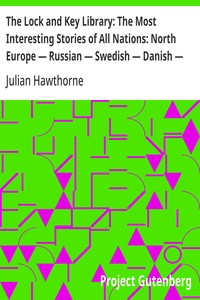
The Lock and Key Library: The Most Interesting Stories of All Nations: North Europe — Russian — Swedish — Danish — Hungarian — A Closer Reading
1258
3
Project Gutenberg
1998
Fiction; Short stories; Detective and mystery stories
Readers of public-domain and historical texts
Project Gutenberg digital edition
en
Edition facts
Words: 126,791
Reading time: 552 min
Text sections: 11
Source:
Project Gutenberg record #1552
This volume collects mystery and detective stories from Russian, Swedish, Danish, and Hungarian authors, edited by Julian Hawthorne. The excerpts show a focus on card games, forged documents, and sudden intrusions, with recurring motifs of locked rooms and concealed identities.
Editorial Edition Score
4.8/5
★★★★★
★★★★★
Calculated from edition completeness, EPUB availability, text structure and catalogue metadata. Not a user rating.
Edition quality
The volume opens with Pushkin's 'The Queen of Spades,' where a card party sets the stage for a tale of obsession and the supernatural. The narrator notes that Hermann, a young engineer, watches play without ever touching a card, declaring he cannot 'sacrifice the necessary in the hope of winning the superfluous.' This tension between restraint and risk recurs throughout the collection.
Later, in Krestovski's 'Knights of Industry,' a group of forgers huddles around a table, preparing false passports. The red-nosed man explains their cover: 'simply reading the political news.' The scene is interrupted by a sudden entrance, a pattern that appears in multiple stories, where locked rooms and unexpected arrivals drive the plot.
Card Games and Calculated Risks
Card games serve as both setting and metaphor in several stories. In 'The Queen of Spades,' the narrator describes a long winter night at Naroumoff's rooms, where players eat heartily after winning but stare at empty plates when they lose. Hermann's refusal to gamble—'I am not in the position to sacrifice the necessary'—sets up his later downfall. The story of Tomsky's grandmother, who once knew a secret sequence of cards, introduces the idea of a hidden system. This motif of calculated risk versus superstition appears again in Bergsøe's 'The Amputated Arms,' where a character's steady hand is tested. The excerpts do not reveal whether the secret is ever learned, but the pattern of wagers and consequences is clear.
Forged Identities and Hidden Papers
In 'Knights of Industry,' Bodlevski seeks a false passport to pose as a noble. The forgers produce a document for 'Maria Solontseva, widow of a college assessor,' obtained by violent means—'Knocked on the head,' as the red-headed man admits. The scene emphasizes secrecy: the group stands 'elbow to elbow,' ready to hide their work if an outsider enters. The red-nosed man explains their ruse: 'simply reading the political news.' This focus on documents and deception recurs in 'The General's Will' and 'The Sealed Room,' where wills and sealed letters hold the key to mysteries. The excerpts suggest that identity is fluid, and papers can be manufactured or stolen.
Sudden Entrances and Interrupted Schemes
Multiple stories hinge on a character bursting into a room. In 'Knights of Industry,' just as Bodlevski is about to agree to the forged passport, 'the outer door was pushed quickly open and a tall man... stepped swiftly into the room.' The intruder, in military uniform, seizes a vial and disrupts the forgers' work. This abrupt shift from conspiracy to confrontation mirrors the opening of 'The Queen of Spades,' where the card party is interrupted by Tomsky's story. The pattern suggests that the collection values dramatic reversals over slow buildup. The excerpts do not reveal the intruder's purpose, but the interruption itself becomes a structural device.
Locked Rooms and Concealed Spaces
The title 'The Lock and Key Library' hints at secrets behind closed doors. In Ingemann's 'The Sealed Room,' the very name evokes a space that cannot be entered. The excerpts show characters guarding their activities: the forgers post a lookout named 'Finch' and keep a newspaper ready as a cover. In 'The Queen of Spades,' the countess's secret is locked in her past. The physical act of locking and unlocking recurs—doors, portfolios, vials. The collection's structure moves between these confined settings: card rooms, study, and the 'Tower Room' of Elck's story. The excerpts do not reveal what lies behind every door, but the pattern of concealment and revelation is consistent.
Readers approaching this anthology should attend to the recurring image of the table—whether for cards, forgery, or interrogation—as a stage where characters reveal their true natures. The stories reward attention to small details: a steady hand, a vial of liquid, a passport from Yaroslav. The volume does not offer a single detective figure; instead, it presents a mosaic of criminals, gamblers, and investigators, each operating within a confined world of risk and deception.
Reader reflection
Take a moment to reflect on this book
Create a short personal record of your experience with this book.
Your progress
0
/
10
2
Was reading this book enjoyable?
3
Is this a title you would suggest to others?
4
How easy was the book to follow?
5
Which element worked best for you?
6
How original did the book feel?
7
What was its emotional impact?
8
Would you like to discuss this book with someone?
9
Which lesson or insight stayed with you?
10

![Cover of Some Short Stories [by Henry James] — Inside the Classic](https://cuiep.com/storage/media/covers/pg2327.jpg)