1

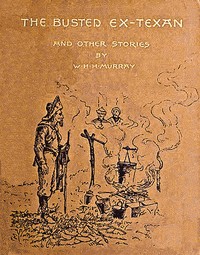
The Busted Ex-Texan, and Other Stories — Themes and Context
285
2
Project Gutenberg
2009
Fiction; Short stories; Western stories
Readers of public-domain and historical texts
Project Gutenberg digital edition
en
Edition facts
Words: 22,030
Reading time: 96 min
Text sections: 3
Source:
Project Gutenberg record #28502
Three stories by W. H. H. Murray, each built around a distinctive narrative voice and a journey or contest. The title tale opens with a campfire confession; the second follows a deacon and parson through a New Year's sleigh race; the third involves a red rose. Recurring motifs include horses, wagers, and sudden shifts between serene description and comic action.
W. H. H. Murray's collection opens with a campfire scene set in the foothills near Kicking Horse Pass, where a party of men and women have made a bivouac under lofty firs. The narrator describes the scene in leisurely, sensory detail—the trickling rivulet, the hammocks swung for the ladies, the laughter and snatches of song—before a stranger appears and announces, "I am a Busted ex-Texan." This abrupt shift from pastoral calm to a character's self-deprecating declaration is the first of several structural pivots in the volume. Across the three stories, Murray repeatedly moves from expansive landscape description to tight, often comic dialogue, and from group harmony to individual confession or contest.
Campfire Confession and the Framing Device
The title story uses a classic frame: a group of travelers at rest, a stranger who joins them, and a tale told in his own voice. The opening pages establish a mood of contentment—"nature responded to our happiness in its kindest mood"—before the ex-Texan's entrance disrupts it. His first words, "I am a Busted ex-Texan," are both a boast and a lament, and the story that follows is a first-person account of misadventure. Murray does not return to the frame at the end of the excerpt, leaving the reader to infer whether the tale is complete. This structure, common in 19th-century short fiction, allows Murray to contrast the narrator's polished, observant prose with the ex-Texan's colloquial, rueful speech.
Horses as Markers of Character and Plot
In "How Deacon Tubman And Parson Whitney Celebrated New Year's," a horse named Jack is described in extraordinary detail: seventeen hands high, ashen roan mottled with patches, a rat-tail, and white rings around his eyes that hint at Arabian blood. The horse's appearance is homely, but his legs are "flat and corded like a racer's." The deacon has kept Jack's racing history secret, and the story builds toward a public race on the village street. Murray uses the horse as a repository of backstory—purchased by the deacon's son from an "impecunious jockey"—and as a device for comic reversal. The description of Jack's gait as "loose, shambling" contrasts with the speed he is rumored to possess, setting up the race as a test of appearances versus reality.
Movement Between Serene and Comic Registers
Murray's prose moves fluidly between lyrical landscape writing and broad comedy. In the opening of the title story, the narrator dwells on the "soft, lapsing sound" of the brook and the "mighty shadow" of the mountain range. A few paragraphs later, the ex-Texan's voice introduces a different tone—self-mocking, anecdotal, full of exaggeration. Similarly, in the second story, the parson's emotional blessing of the children ("God bless them! God bless them!") is followed immediately by a detailed, almost clinical description of the horse's homely physique. These shifts are not jarring but deliberate: Murray uses the contrast to keep the reader off balance, moving from sentiment to humor without warning. The effect is a narrative voice that is both observant and wry.
Illustrations and the Visual Imagination
The book includes eight full-page illustrations by Thos. Worth, listed in the front matter with captions such as "Practically Inside the Pail" and "Luff Her Up—Luff Her Up." These captions hint at physical comedy and action—someone inside a pail, a nautical command—that may correspond to moments in the stories. The illustrations are not reproduced in the Project Gutenberg text, but their presence suggests that Murray and Worth collaborated to emphasize visual set pieces: a character in a ridiculous predicament, a horse race, a struggle. Readers of the digital edition should imagine these scenes as part of the work's intended effect, with Worth's images amplifying the humor and movement that Murray's prose describes.
Because the excerpts are incomplete—the third story, "The Leaf Of Red Rose," is not included—readers should approach this collection as a set of three independent tales linked by Murray's interest in voice, setting, and the unexpected turn. Pay attention to how each story begins: with a group, a landscape, and a shift into a character's own words. The horses, the wagers, and the sudden bursts of action are not merely decoration but the engine of the plot.
Reader reflection
What did you think of this book?
Answer a few questions and save a private reflection on this device.
Your progress
0
/
10
2
How did the book work for you overall?
3
Would you encourage someone else to read it?
4
Did the language feel accessible?
5
How strongly did the book affect you emotionally?
6
How would you describe its reading pace?
7
Did it raise ideas you would like to talk about?
8
Do you expect to return to this book?
9
What did this book teach you most?
10