1

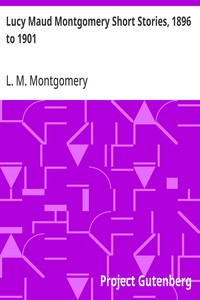
Lucy Maud Montgomery Short Stories, 1905 to 1906 — Context and Discussion
1227
2
Project Gutenberg
2008
Short stories, Canadian
Readers of public-domain and historical texts
Project Gutenberg digital edition
en
Edition facts
Words: 94,864
Reading time: 413 min
Text sections: 11
Source:
Project Gutenberg record #24876
This collection of 28 short stories by L. M. Montgomery, published between 1905 and 1906, showcases her early narrative voice through rural settings, community dilemmas, and resourceful protagonists. The excerpts reveal a pattern of characters overcoming obstacles via cleverness and cooperation, with vivid sensory details and a focus on moral growth.
Editorial Edition Score
4.8/5
★★★★★
★★★★★
Calculated from edition completeness, EPUB availability, text structure and catalogue metadata. Not a user rating.
Edition quality
The opening story, “A Correspondence and a Climax,” immediately establishes a hallmark of Montgomery’s short fiction: a young woman’s inner life set against a vividly described rural landscape. Sidney, the protagonist, milks cows in a “stuffy little pen” and endures a household filled with “reek of bad tobacco smoke” and quarrelling children. Her only escape is a monthly letter, which she composes while working. This contrast between drudgery and private aspiration recurs throughout the collection.
In “The Christmas Surprise at Enderly Road,” two men help a girl named Maggie decorate a schoolhouse after local boys renege on a promise. The story hinges on a secret nighttime operation—complete with a lantern, step-ladder, and cardboard mottoes—that transforms a plain room. Montgomery’s prose here is brisk and detail-oriented, focusing on the physical actions of the helpers rather than emotional commentary.
Recurring Patterns in the Opening Pages
Across the excerpts, Montgomery frequently opens stories with a character in a state of physical exertion or emotional distress. Sidney’s milking, Maggie’s tears, and the unnamed narrator’s encounter with a crying girl all establish tension quickly. The settings are domestic or school-related, and the conflicts are small-scale: a broken promise, a lack of resources, a personal grudge. Montgomery does not begin with grand declarations but with concrete, sensory details—the “blue-print afternoon dress,” the “little red knuckles,” the “unlit lantern.” These details ground the reader in a specific time and place.
Another pattern is the immediate introduction of a helper or ally. In “A Correspondence and a Climax,” Sidney’s letter-writing is a solitary act, but the story soon involves other characters. In “The Christmas Surprise,” Frank and the narrator step in to assist Maggie. Montgomery’s openings often pair a vulnerable character with a more capable one, setting up a dynamic of mentorship or collaboration that drives the plot.
The Role of Community and Collective Action
Several stories in this collection revolve around a group working together to solve a problem. In “The Christmas Surprise at Enderly Road,” the solution is explicitly communal: Frank, the narrator, and their sisters Carrie and Mabel all contribute to the decorating plan. The narrative emphasizes the division of labor—Carrie and Mabel make mottoes and tissue roses, while the men handle the physical work of tacking them up. Montgomery shows that success depends on each person’s specific contribution.
Similarly, in “A Correspondence and a Climax,” Sidney’s letter is not merely a private outlet; it initiates a correspondence that presumably involves another person. The excerpts do not reveal the outcome, but the act of writing is itself a form of reaching out. Montgomery’s characters rarely solve problems alone; they seek or receive help from friends, siblings, or strangers. This emphasis on interdependence gives the stories a warm, cooperative tone, even when the initial situation is bleak.
Sensory Details and Atmospheric Description
Montgomery’s prose in these stories is rich with sensory information that creates a vivid sense of place. In the opening of “A Correspondence and a Climax,” the reader can smell the “bad tobacco smoke” and feel the “fag-end of a hot summer day.” The milking pen is “stuffy,” and Sidney’s distaste is physical, “tingling to her rosy fingertips.” These details make the setting tangible and immediate.
In “The Christmas Surprise,” the schoolhouse is described as “small” with “old-fashioned furniture” that “bore marks of hard usage,” but it is also “very snug” and clean. The contrast between the worn furniture and the careful sweeping underscores the children’s pride in their space. Montgomery also uses light and darkness effectively: the lantern is “unlit” when the men arrive, and they work by its glow after lighting it. The isolation of the schoolhouse, “quite out of sight of any inhabited spot,” adds a note of secrecy and adventure to the decorating mission.
Moral Lessons and Character Growth
While the excerpts do not reveal complete story arcs, they strongly suggest that Montgomery’s tales carry moral weight. In “The Christmas Surprise,” Frank’s motivation is explicitly to “spoil Matt Dickey’s little game” and “do Maggie a good turn.” The story frames Matt’s behavior—refusing to help because of a grudge against the teacher—as petty and wrong. The helpers’ actions are presented as both practical and righteous.
Similarly, Sidney’s dissatisfaction with her farm life hints at a desire for something more, and her letter-writing may lead to personal growth or a change in circumstances. Montgomery often uses a crisis or disappointment as a catalyst for character development. The stories do not preach, but they consistently reward kindness, resourcefulness, and cooperation. Readers can expect each narrative to conclude with a restored sense of order or a lesson learned, though the specific outcomes vary.
As you read through these twenty-eight stories, pay attention to how Montgomery balances external action with internal reflection. The characters’ physical tasks—milking, decorating, walking—often mirror their emotional states. Notice also the recurring motif of letters, gifts, and surprises as plot devices. The stories are brief, but they reward close reading of their descriptive passages and dialogue. Let the sensory details guide your sense of each story’s mood, and watch for the quiet moments when a character makes a decision that changes their trajectory.
Reader reflection
How did this book work for you?
Your answers remain private and are stored only in this browser.
Your progress
0
/
10
2
What was your overall reaction to the book?
3
How likely are you to recommend this book?
4
What was the reading difficulty like?
5
Could you follow the author’s main argument?
6
How distinctive were its ideas or approach?
7
Which element worked best for you?
8
Did you gain anything practical from the text?
9
What did this book teach you most?
10