1

Murder mask — Background and Themes
3101
6
Project Gutenberg
2025
Short stories; Horror tales; Masks -- Fiction
Readers of public-domain and historical texts
Project Gutenberg digital edition
en
Edition facts
Words: 6,067
Reading time: 27 min
Text sections: 1
Source:
Project Gutenberg record #76592
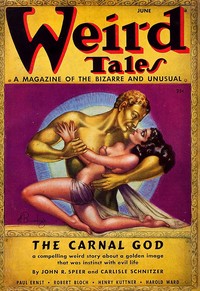
Edgar Daniel Kramer's 1937 Weird Tales story uses a cursed medieval mask and a poisoned will to drive a compact revenge plot. The prose relies on lurid simile, theatrical dialogue, and a tight three-character cast to escalate from drawing-room tension to a double suicide.
Editorial Edition Score
4.3/5
★★★★★
★★★★★
Calculated from edition completeness, EPUB availability, text structure and catalogue metadata. Not a user rating.
Edition quality
Edgar Daniel Kramer's 1937 story, first published in Weird Tales, opens with a butler who would rather meet the Devil than announce a visitor. That visitor, Antonio Colletti, is described with a vocabulary of menace: he moves with "the lithe, slinking movements of a velvet-footed jungle beast," and his breath issues as a "reptilian hiss." The prose wastes no time establishing a moral atmosphere—Colletti's presence "took the warmth from the sunlight."
The plot engine is a medieval mask accompanied by a dog-eared card bearing a four-line rhyme: "Who wears this mask / Is doomed to slay / Whom he loves best, / Ere break of day!" Kramer's diction throughout favors the lurid and the precise: a silk mask lies "like a clot of blood on the polished mahogany," and Colletti's face hardens into "olive granite." The story's 6,000 words move swiftly from exposition to a grim, symmetrical conclusion.
Diction of the Grotesque
Kramer's word choices consistently push toward the visceral and the archaic. The butler's voice is "cracked" and "quavering"; Colletti's gaze is "inscrutable" and fastened on a gardenia. Similes are drawn from the natural world at its most predatory: Colletti is compared to a "rattler ready to strike," and his evil is "like a miasma lifting from a fen." The effect is a prose that feels both overwrought and deliberately controlled—every metaphor serves to isolate Colletti as something inhuman.
The mask itself is never described in detail; its power is conveyed entirely through the reactions it provokes. When Colletti dons it, his body "writhes horribly" and he appears to wrestle an "invisible antagonist." Kramer avoids explaining the mask's origin or mechanism, keeping the focus on its immediate, physical effect. The language of the story is the primary vehicle for its horror, not any elaborate supernatural system.
Dialogue as Incantation
The story's dialogue is sparse but ritualistic. The key exchange occurs near the climax, when Tomaso Romani recites the mask's rhyme back at Colletti, line by line, as a kind of curse. "Who wears this mask!" he growls. "Is doomed to slay! Murder, Tony! Whom he loves best! That's yourself, Tony!" The repetition transforms the rhyme from a warning into a command. Romani's lines are punctuated with exclamation points and direct address, creating a rhythm that feels like a chant or a legal pronouncement.
Earlier, Colletti's own speech is minimal; his thoughts are rendered in indirect narration. The contrast between his internal scheming and Romani's vocal, accusatory dialogue heightens the final confrontation. Kramer uses dialogue not to develop character but to advance the plot's fatal logic: the mask's curse must be fulfilled, and Romani's words ensure it is.
Structure and the Will
The story's plot is driven by a single piece of exposition: the grandfather's will, which ties the inheritance to Nita's marriage and children. This legal mechanism is introduced in a long paragraph that interrupts the opening scene, providing the motive for Colletti's hatred. The will is a classic gothic device—a document that dictates the characters' fates—but Kramer uses it efficiently, establishing the stakes in a few sentences.
The narrative then moves through a series of tightly linked scenes: Colletti's arrival, his donning of the mask, a party, and the final confrontation. There is no subplot. The story's brevity (6,067 words) forces Kramer to compress motivation and consequence into a single evening. The mask's curse and the will's terms are parallel structures: both are inflexible, both lead to death. The story's ending—Romani stabbing himself after kissing his dead wife—completes the symmetry with a literal double suicide.
Setting and Atmosphere
The story is set almost entirely in a single location: the drawing-room of the grandfather's house. Kramer establishes the room as "sun-flooded" at the start, but Colletti's presence drains it of warmth. The only other setting mentioned is a party, heard through muted strains of a waltz and the chorus of "Good-night, Ladies." The party remains offstage, a background hum that contrasts with the intimate violence of the drawing-room.
Time is compressed: the story begins in daylight and ends at dawn. The mask's deadline—"Ere break of day"—gives the narrative a countdown structure. Kramer uses the gray dawn as a final image, peering in at the window after the deaths. The setting is minimal but functional, providing a stage for the characters' actions without distracting from the central prop: the mask. The story's atmosphere depends on this stark, almost theatrical simplicity.
Readers attentive to Kramer's prose will notice how he builds horror through accumulation: the butler's crossed himself, the gardenia, the hiss, the clot of silk. The mask itself is almost an afterthought—the real engine is the will and the characters' willingness to believe in the curse. This is a story that rewards close attention to its language, not its logic. For those interested in the mechanics of the Weird Tales style, Murder Mask offers a compact, efficient example of how diction and structure can create a sense of inevitable doom.
Reader reflection
What did you think of this book?
Answer a few questions and save a private reflection on this device.
Your progress
0
/
10
2
Did this book hold your interest?
3
Would you encourage someone else to read it?
4
How much effort did this book require?
5
Was the book what you thought it would be?
6
Would you like to discuss this book with someone?
7
Is this a title worth rereading?
8
Did anything about the book feel genuinely new?
9
What changed or sharpened your thinking?
10