1

The land beyond the mist — Background and Themes
34
8
Project Gutenberg
2025
Short stories; Western stories; Oregon -- Fiction
Readers of public-domain and historical texts
Project Gutenberg digital edition
en
Edition facts
Words: 10,924
Reading time: 48 min
Text sections: 2
Source:
Project Gutenberg record #76947
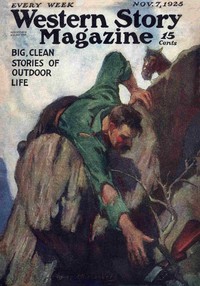
Ernest Haycox's 1925 short story follows Tom Cameron and a wagon train's final push through Oregon's November rain. The narrative shifts from weary slogging to tense pursuit, with language that mirrors the characters' dwindling hope and sudden urgency.
Editorial Edition Score
4.5/5
★★★★★
★★★★★
Calculated from edition completeness, EPUB availability, text structure and catalogue metadata. Not a user rating.
Edition quality
Ernest Haycox opens The Land Beyond the Mist with a precise sensory assault: seven days of Oregon rain, a "heavy rolling mist" that isolates the wagons, and Tom Cameron singing to keep out misery. The prose itself feels waterlogged—sentences drip with participles and compound clauses, mimicking the relentless seepage. Haycox builds the scene through accumulating physical detail: a pony with "huge lumps of gummy clay" on its hoofs, a capote that "dripped water like a colander sieve," and a mustache wrung free of water. This opening establishes a voice that is both folksy and exact, blending colloquial dialogue with a narrator who catalogs discomfort with clinical precision.
Voice and the Weight of Weather
Haycox's narrative voice in the first excerpt is defined by its immersion in the physical world. The prose is dense with material specifics—"blanket capote," "buckskin breeches," "jerked venison and chicory coffee"—that ground the story in the Oregon Trail's material reality. The narrator's tone is detached yet sympathetic, reporting misery without melodrama. Dialogue, by contrast, is compressed and idiomatic: Tom's "I'd be a danged sight more dry if I turned this hyar shirt inside out" and Warner's "I'm a durned fool" use dialect to mark character. The shift between these registers—the narrator's measured accumulation of detail and the characters' terse, weary speech—creates a rhythm that mirrors the slog of travel.
Pace and the Sudden Turn
The story's pace changes abruptly when Warner reveals that three men have learned of the valley. The earlier paragraphs, built from long, compound sentences and repetitive clauses ("They came to a hill and slid down side-wise... They fought across a swollen creek..."), give way to shorter, more urgent constructions: "Cameron sat rigid. Treachery?" The narrative shifts from description to action, with verbs like "shoved," "plunged," and "fought" replacing the earlier static verbs of endurance. Haycox signals this change through the characters' physical states—Cameron's "hand that shook like an aspen leaf" and Follett's rare curses—as the rain and fog become not just obstacles but a backdrop for human conflict.
Recurring Details and the Unseen
Throughout the excerpts, Haycox returns to a few key images: the mist that "shut them out from the rest of the world," the "eternal" rain, and the "everlasting, dismal firs." These repetitions create a sense of enclosure and monotony, but they also serve as a counterpoint to the characters' internal urgency. The mist is both literal and metaphorical—it hides the trail, the valley, and the intentions of the Emory boys. The soundscape, too, is carefully layered: the "clack and clatter of vehicles," the "wailing of infants," a hymn that "cracked in the middle of the verse." These details build a world that feels both historically specific and psychologically oppressive, where the promised land remains unseen, hidden behind the fog.
Readers should attend to how Haycox uses the weather not merely as setting but as a narrative engine—the rain and fog dictate the pace, shape the characters' moods, and obscure the threats that drive the plot. The story's brevity (under 11,000 words) means that every descriptive passage carries weight; the shift from weary cataloging to tense pursuit is the story's central structural move. Watch for how the language itself becomes more urgent as the characters near their goal, and how the mist, which initially seemed merely oppressive, becomes a veil for human treachery.
Reader reflection
Your personal reading reflection
Build a private reading journal entry for this title.
Your progress
0
/
10
2
How much did you enjoy the reading experience?
3
Is this a title you would suggest to others?
4
How much effort did this book require?
5
Which element worked best for you?
6
How clear did the writing feel?
7
Did any part of the book feel personally relevant?
8
How useful did the reading feel?
9
What changed or sharpened your thinking?
10


![Cover of Some Short Stories [by Henry James] — Inside the Classic](https://cuiep.com/storage/media/covers/pg2327.jpg)